Some key highlights of engagement the Sheep Genetics team has had with clients, Service Providers, and the greater industry is summarised in Table X.
Table X. Key engagement events for the Sheep Genetics team in the past 12 months
|
Event |
Date(s) |
Impact/comments |
|
Performance Breeder Groups
- |
17-19th February 2025 - Meat Elite & Superwhites, 21st March, 2025 - Maternal Performance Group 3-4th June, 2025 - Merino Breeders Group |
Each year Sheep Genetics works with key groups of highly engaged breeders to communicate the most recent updates to the Sheep Genetics analysis and discuss how breeders can drive more genetic gain and improving their data quality. This year was the first year that a Performance Maternal Group was held and was highly successful and the feedback was very positive from group members. Members of the performance groups contribute a significant impact to the Sheep Genetics evaluation, with 24.4%, 57%, and 29.1% of lambs in the respective evaluations being sired by rams bred by performance group members of Meat Elite & Superwhites, the Maternal Performance Group, and the Merino Breeders Group, respectively. |
|
Service Provider |
30th April & 1st of May, 2025 |
35 attendees, which are Service Providers for a total of 383 flocks (~40%) in the Sheep Genetics analysis. Sheep Genetics runs an annual Service Provider workshop with a group of highly engages Service Providers. The focus of the 2025 workshop was to provide updates on Combined LAMBPLAN, other project updates, discuss data quality and how to improve it in flocks, and component reproduction. Attendees range from data managers to genetics advisors, with software and genomic companies also attending the workshop. |
|
Scanner Accreditation |
19-20th March, 2025 |
8 scanners attended, which measure fat and muscle phenotypes for 512 flocks (~50%) of the Sheep Genetics analysis. There were also 3 new scanners that attended the accreditation training in 2025, 2 of which became accredited scanners. The 2025 accreditation was run a little differently to past years, with this years accreditation focused on training and refinement of technique. It was attended by longstanding scanners as well as new attendees that have never been a Sheep Genetics accredited scanner. This accreditation is part of the Sheep Genetics data quality assurance protocols. All Fat and Muscle scans coming into the analysis must be measured by an accredited scanner. Scanners must pass accreditation ever 2 years. |
|
AAABG |
24-26th June, 2025 |
The 26th Association for the Advancement of Animal Breeding and Genetics (AAABG) was held in Queenstown, NZ in June 2025. Andrew, Peta, Kate, and Marnie attended the conference to gain a deeper understanding of the latest advancements in livestock genetics R&D, as well as foster relationships with world-leading researchers and scientists, as well as international clients and service providers. There were 120 papers total in the conference: - 2 relating to OVIS consent projects - 3 presented by SG staff - 3 relating to the software (BREEDPLAN and OVIS) - 2 relating to SG data - 28 from MLA funded research - 38/120 papers – 32% of papers arose from MLA funded research or arising from interest as an Owner of BP and OVIS Whilst in NZ, Peta, Kate, and Marnie also presented at two half day workshops for NZ Sheep Genetics clients. |
The Sheep Genetics team have been very busy over the past 12 months supporting and attending over 40 events. These included attendance from Sheep Genetics clients, commercial ram breeders, industry service providers, and agriculture students at in-person workshops, field days, conferences, open days, online workshops, lectures, and more. These events provide a great opportunity for the Sheep Genetics team to get out and catch up with clients face-to-face and discuss the latest and greatest of Sheep Genetics, as well as help inform commercial ram buyers and students on the importance of Sheep Genetics evaluation.
|
Month |
Event |
|
July 2024 |
|
|
August 2024 |
|
|
September 2024 |
|
|
October 2024 |
|
|
November 2024 |
|
|
December 2024 |
|
|
January 2025 |
|
|
February 2025
|
|
|
March 2025 |
|
|
April 2025 |
|
|
May 2025 |
|
|
June 2025 |
|
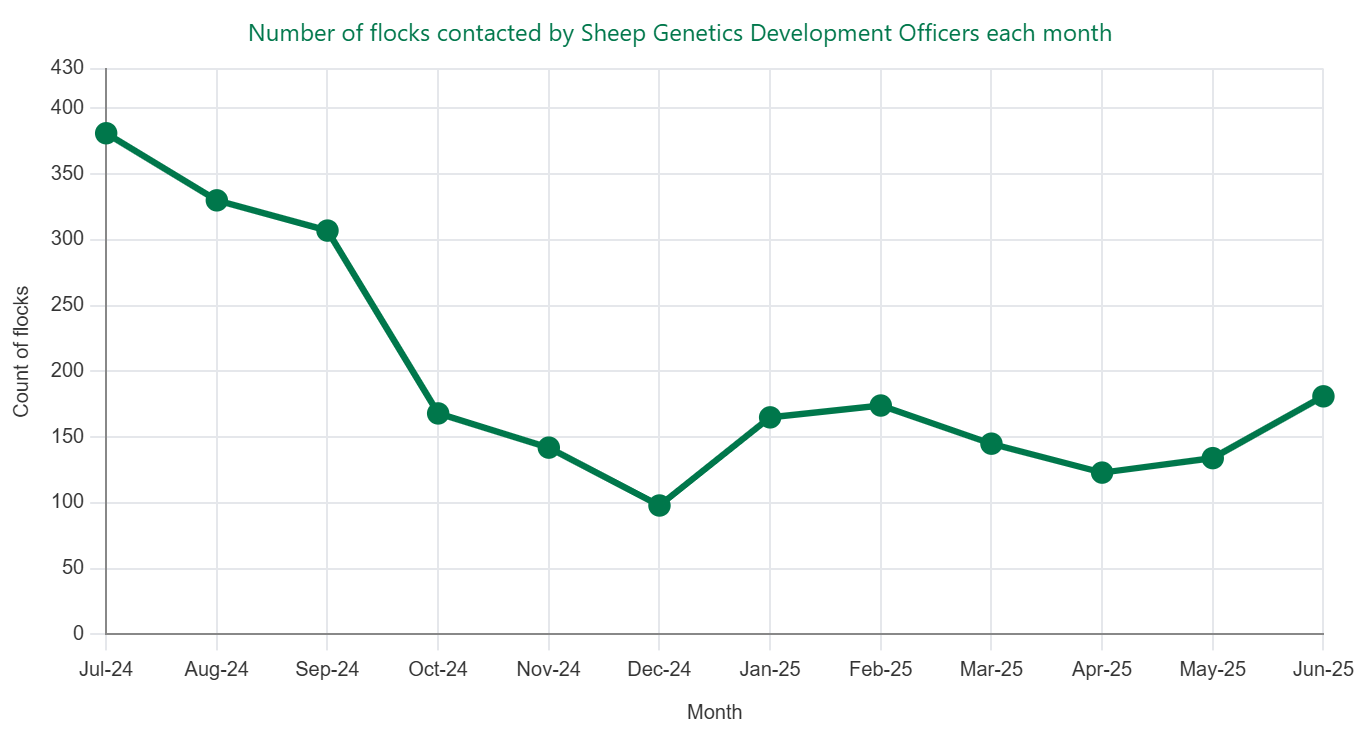
The Development Officers have had a busy 12 months engaging with clients either during face-to-face workshops/events, on the phone or via email to answer queries, questions, and overall improve the understanding and use of the Sheep Genetics analysis. Table X shows a monthly breakdown of the number of flocks that the Sheep Genetics Development Officers have engaged with over the past 12 months.
Table X. Number of flocks the Sheep Genetics Development Officers contacted each month
|
Month |
Count |
|
Jul-24 |
381 |
|
Aug-24 |
330 |
|
Sep-24 |
307 |
|
Oct-24 |
168 |
|
Nov-24 |
142 |
|
Dec-24 |
98 |
|
Jan-25 |
165 |
|
Feb-25 |
174 |
|
Mar-25 |
145 |
|
Apr-25 |
123 |
|
May-25 |
134 |
|
Jun-25 |
181 |
On top of this, the Sheep Genetics Development Officers had one-on-ones with 21 flocks, discussing data quality, breeding program designs, phenotyping protocols, and how to optimise their genetic gain. The Development Officers has several online meetings with commercial ram buyer clients also to und their Flock Profile results and how to use their Flock Profile when informing ram purchasing and culling decisions to ensure producers at meeting their breeding objectives.
The team at Sheep Genetics aims to promote interest and understanding of genetics and the importance of genetic selection into the next generation, with the Sheep Genetics Development Officers delivering several lectures and tutorials over the past 12 months.
Instilling genetics concepts early for students is important to ensure they enter the workplace with an understanding of what ASBVs are, how to implement genetic selection into their workplace, and the benefits genetic selection can have on farm productivity and profitability.
The Sheep Genetics team helped foster this by delivering guest lectures and tutorials for university students at
High school students heard from the Sheep Genetics team at RYAG events in Walcha and the Ross McKenzie workshop which was delivered to students from several schools at the Australian Sheep and Wool Show in Bendigo.
MateSel is a genetic selection tool which can help sheep breeders identify animals to breed from to make genetic gain whilst managing inbreeding and co-ancestry. Sheep Genetics Development Officers run MateSel training and accreditation multiple times a year, as it is a powerful tool used for genetic selection and requires comprehensive understanding before use. A total of 21 Sheep Genetics clients attended and passed MateSel training over the past 12 months. Of the 21 clients that attended and passed MateSel training, their knowledge on MateSel increased by 140%.
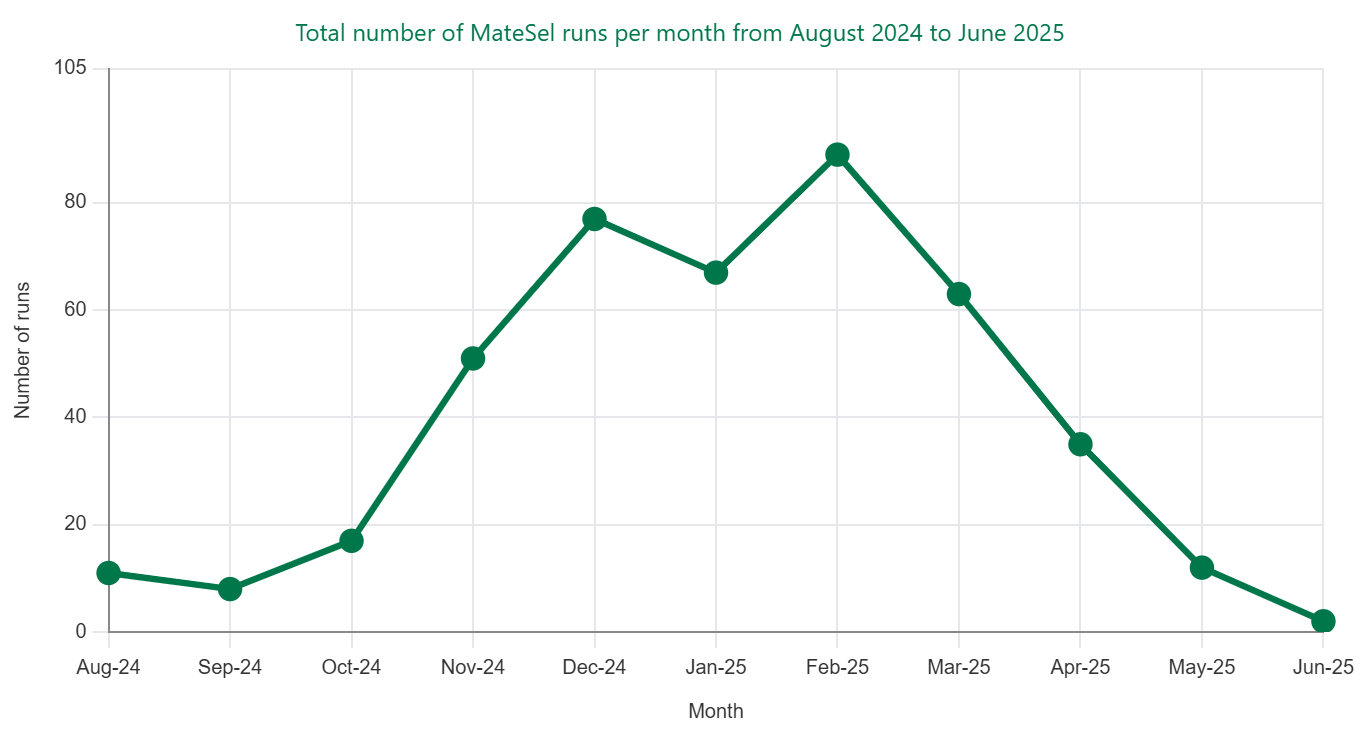
There are 275 Sheep Genetics members and Service Providers with MateSel access that span across 1,034 flocks. Table X shows the total number of MateSel runs each month over the course of the last year. The number of MateSel runs increased by 106% in 2024-25 from 2023-24.
Table X. Total number of MateSel runs per month from August 2024 to June 2025
|
Month |
Number of runs |
|
Aug 24 |
11 |
|
Sep 24 |
8 |
|
Oct 24 |
17 |
|
Nov 24 |
51 |
|
Dec 24 |
77 |
|
Jan 25 |
67 |
|
Feb 25 |
89 |
|
Mar 25 |
63 |
|
Apr 25 |
35 |
|
May 25 |
12 |
|
June 25 |
2 |
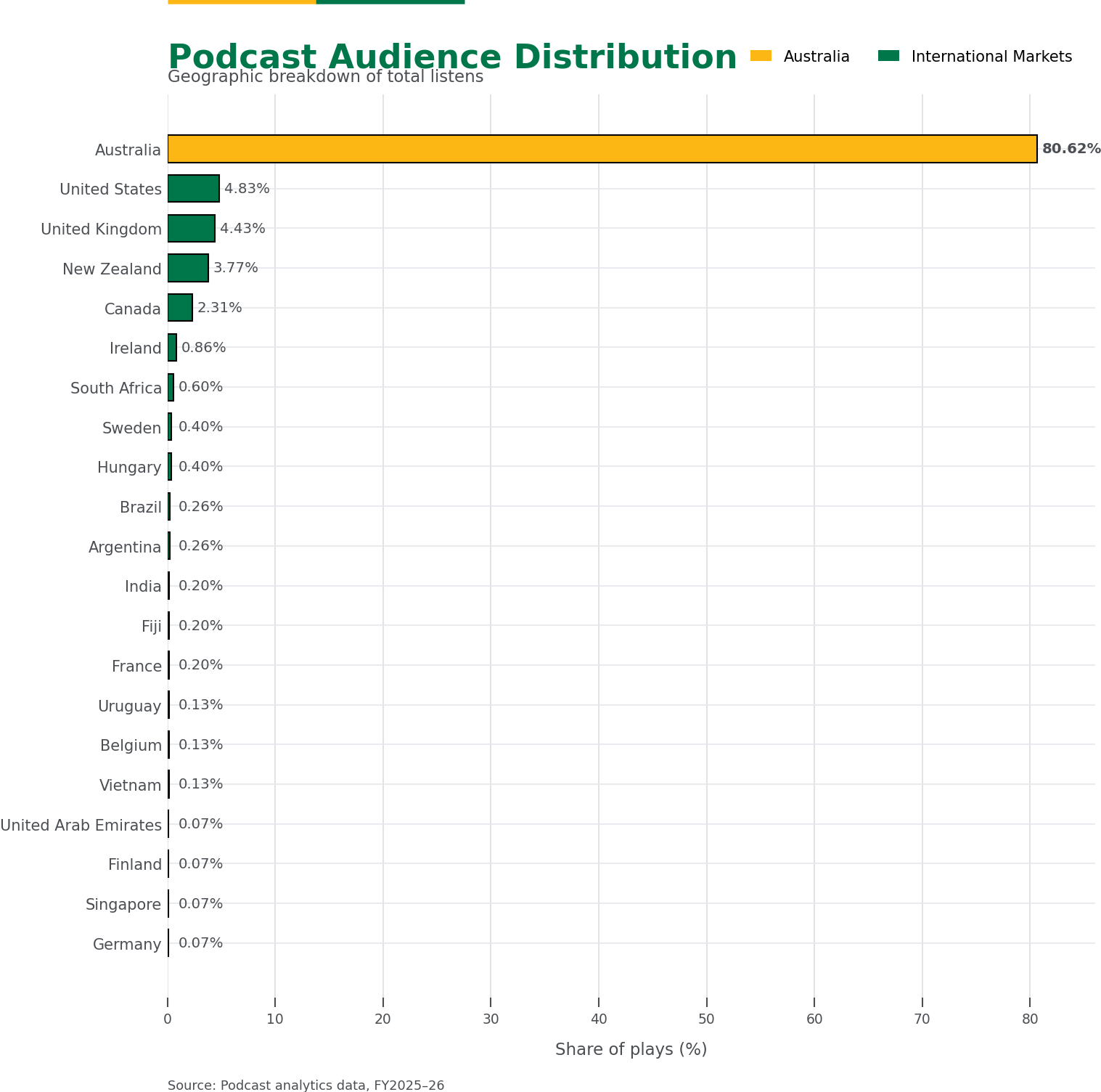
After it’s release in May 2024, Ewe-niquely Genetics has gain impressive traction with listeners. With now over 9 episodes to listen to, Ewe-uniquely Genetics has had 1,487 plays in the past 12 months with listeners spanning over 20 countries (if including, please include Figure of highlighted world map??)! Ewe-uniquely Genetics has a 44.4% conversion rate, translating to over 308 listening hours of Ewe-uniquely Genetics by 333 Spotify users.
|
Geo |
Percent of Plays |
|
Australia |
0.8062169312169312 |
|
United States |
0.048280423 |
|
United Kingdom |
0.044312169 |
|
New Zealand |
0.037698412698412696 |
|
Canada |
0.023148148148148147 |
|
Ireland |
0.008597884 |
|
South Africa |
0.005952381 |
|
Sweden |
0.003968254 |
|
Hungary |
0.003968254 |
|
Brazil |
0.002645503 |
|
Argentina |
0.002645503 |
|
India |
0.001984127 |
|
Fiji |
0.001984127 |
|
France |
0.001984127 |
|
Uruguay |
0.001322751 |
|
Belgium |
0.001322751 |
|
Vietnam |
0.001322751 |
|
United Arab Emirates |
0.000661376 |
|
Finland |
0.000661376 |
|
Singapore |
0.000661376 |
|
Germany |
0.000661376 |
Episode 5 – the reach of genetics research
Episode 6 – genetics for all
Episode 7 – ASBV breakdown
Episode 8 – Following the genomics pipeline
Episode 9 – Mastering MateSel
High quality data is significantly correlated with higher rates of genetic gain, due to increased accuracy of ASBVs and therefore a higher selection accuracy. Sheep Genetics members have access to a Data Quality Score (DQS) Report which highlights important aspects of data quality including:
The DQS report provides a rating out of 100 and a star rating (out of 5), as well as providing up to three areas to improve and strengths in data quality for each flock. The DQS Report is heavily used by the Sheep Genetics Development Officers when talking to flocks about how to improve their data quality and rates of genetic gain.
Over the past 12 months, the Sheep Genetics Development Officers have been busy over identifying key areas of data quality to contact relevant flocks about and work with breeders to improve their data quality using the metrics captured in the DQS report and other key aspects of data quality. Focused efforts have been made to improve the following data quality metrics:
The push to improve data quality in the genetic evaluations has seen a significant improvement in the above data quality metrics. This effort from the Development Officers will continue into the future to ensure that the highest quality data is being used to calculate ASBVs, which in turn will have a positive influence on selection accurate and rates of genetic gain. The Sheep Genetics Development Officers also presented the importance of a range of data quality metrics to Service Providers and key Performance Group members across the last 12 months also, providing individual summaries of ways to improve to flocks and Service Providers.
In December 2024, there were 142 flocks that received an award for 5-star data quality
In June 2025, there were 120 flocks that received an award for 5-star data quality
18 new flocks received a 5-star data quality award in June 2025